

Many tract homes throughout San Diego County were built with concrete or clay tile roofs designed to create attractive, durable neighborhoods at scale. The tile itself can remain serviceable for decades, but that does not mean the entire roofing system beneath it is performing correctly. At San Diego County Roofing & Solar, we frequently find that problems on aging tract-home tile roofs are connected not to the visible tile but to underlayment, flashing, drainage details, penetrations, and installation methods hidden below the surface.
For homeowners, this distinction matters. A tile roof can appear almost perfect from the street while water is already reaching deteriorated underlayment or vulnerable roof-to-wall transitions underneath it.
Why Tract-Home Tile Roofs Develop Similar Problems
Tract developments are built differently from one-off custom homes. A builder may construct dozens or hundreds of houses using similar floor plans, roof pitches, framing layouts, materials, and subcontractors.
That creates efficiency, but it also means the same roofing detail may be repeated across an entire neighborhood.
In San Diego communities developed during major housing-growth periods, we often see groups of homes reaching similar stages of roof aging at approximately the same time. Houses may have the same tile profile, similar underlayment, identical valleys, comparable second-story wall intersections, and nearly identical plumbing vent locations.
A weakness repeated during original construction can therefore become a neighborhood-wide pattern decades later.
This does not mean every tract-home tile roof was installed incorrectly. It means homeowners should evaluate the complete roofing assembly instead of assuming that intact-looking tiles confirm that everything underneath them remains watertight.
The Tile Is Only One Part of the Roof
One of the biggest misconceptions about tile roofing is that the tile itself creates the entire waterproof barrier.
Concrete and clay tiles primarily shed water. Wind-driven rain, minor amounts of moisture, and water moving through tile joints can still reach components below the tile. That makes the underlayment, flashings, penetrations, valleys, transitions, and drainage path critically important.
The current Tile Roofing Industry Alliance installation guidance addresses the roofing system as a combination of tile, underlayment, fastening, flashing, eave, valley, hip, ridge, penetration, and roof-to-wall details rather than treating tile as an isolated surface material.
When those concealed components deteriorate, replacing one cracked tile may do little to solve the real problem.
Aging Underlayment Is a Major Concern
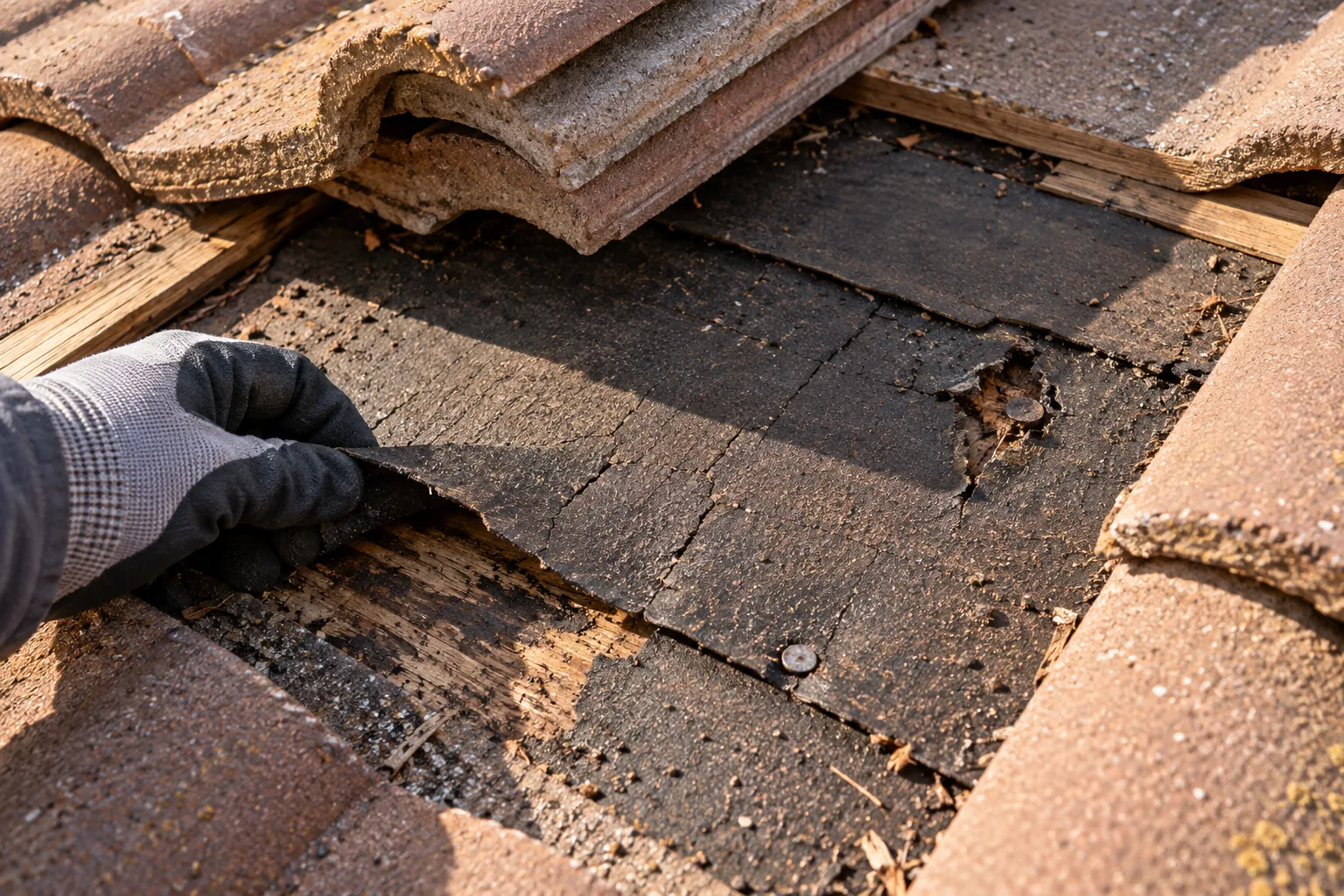
Underlayment is one of the most important components we examine on an older tract-home tile roof.
It sits directly over the roof deck and beneath the tiles, where homeowners normally cannot see its condition. Over years of service, it is exposed to heat cycling, movement of the roofing system, moisture, penetrations, debris, and localized water intrusion.
Older roofing assemblies may contain asphalt-saturated felt or other underlayment systems that have become brittle, torn, cracked, separated, or damaged around fasteners.
The deterioration can be highly localized. Underlayment beneath most of a roof may still appear relatively stable while areas around valleys, walls, pipes, chimneys, skylights, or eaves are already failing.
That is one reason leak diagnosis should focus on the water path rather than simply the interior stain.
Low-Slope Tile Roof Areas Need Particular Attention
Roof pitch affects how quickly water drains.
Current industry installation guidance specifies additional underlayment protection on lower-slope tile roofs. For slopes from 2½:12 up to 4:12, the TRIA manual specifies a minimum two-layer underlayment system within the conditions covered by the guide.
This matters on tract homes because one house may contain several different roof geometries. A steep main roof can perform differently from a lower garage roof, patio transition, entry section, or architectural projection.
Whenever water moves more slowly, small deficiencies become more important.
Roof-to-Wall Flashing Can Create Hidden Leaks
Two-story tract homes frequently contain lower roof sections that terminate against an upper-story wall.
These roof-to-wall intersections are critical.
Water must move down the wall, onto properly integrated flashing, and safely across the tile roof toward the eave. Problems develop when flashing is too short, improperly lapped, obstructed, damaged during later construction, or poorly integrated with the underlayment.
The result can be confusing because the interior leak may appear several feet away from the actual entry point.
Current tile installation standards require flashing at wall and roof intersections, changes in roof slope or direction, and roof openings. The current TRIA manual also specifies minimum corrosion-resistant metal requirements, including 0.019-inch galvanized steel or aluminum among recognized flashing materials.
Chimneys, Skylights, and Penetrations Are Common Trouble Areas
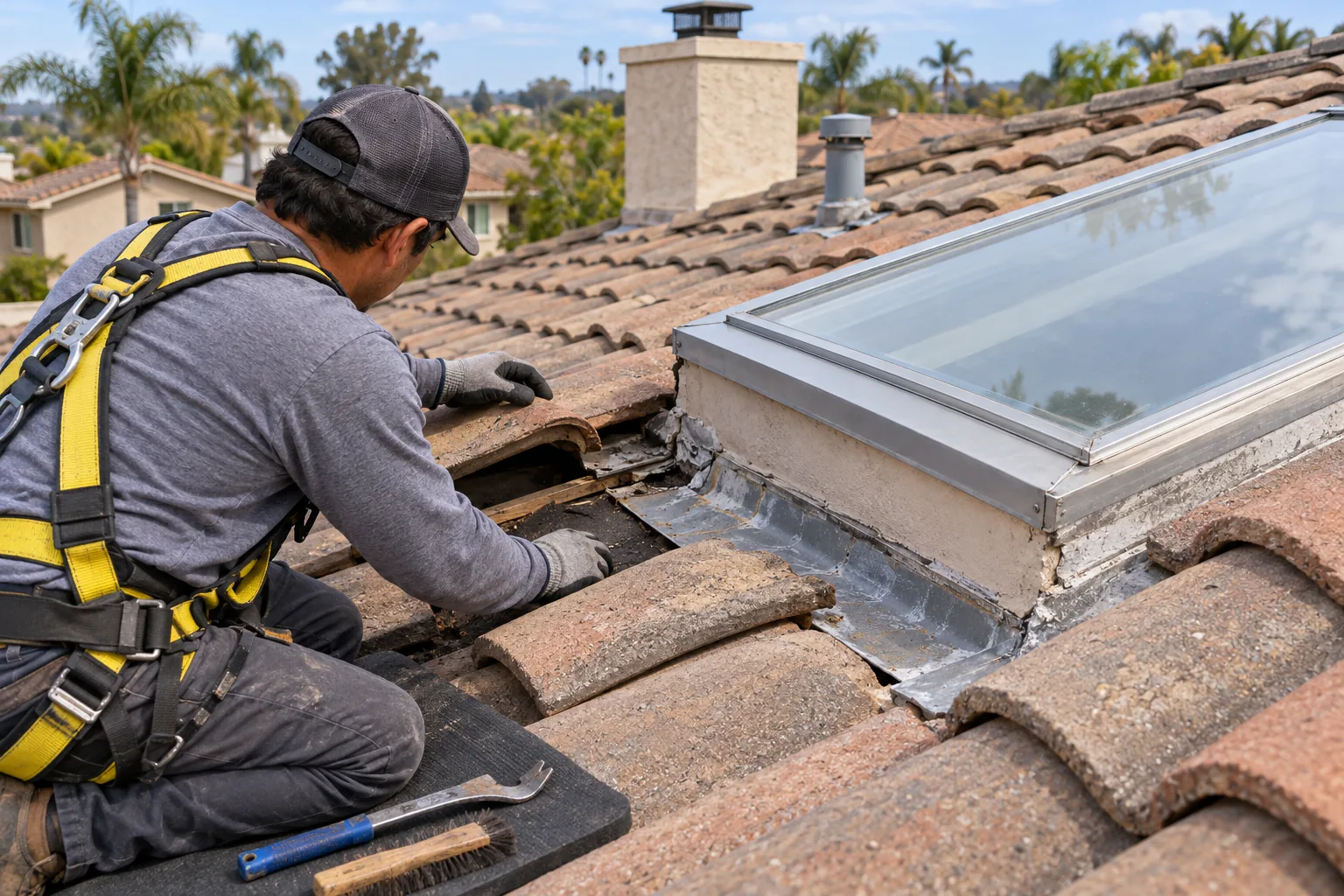
Anything passing through a tile roof creates an interruption in the drainage system.
Typical tract-home roofs may contain plumbing vents, exhaust vents, chimneys, skylights, attic vents, satellite attachments, and later-added solar equipment.
Every penetration must manage water at more than one level. Tile flashing handles water at the exposed roof surface, while properly integrated deck-level flashing and underlayment provide secondary protection beneath the tile.
A sealant-only approach is rarely equivalent to correctly designed flashing.
Roofing cement or caulk may temporarily hide symptoms around a leaking penetration, but it can deteriorate and does not automatically correct an underlying flashing defect.
Eave Problems Can Cause Fascia and Deck Damage
The lower edge of a tile roof performs several important functions.
Water reaching the eave must drain cleanly away from the roof assembly. Tiles must also be properly supported at the first course so their angle remains consistent with the rest of the roof.
Improper eave details can interfere with drainage beneath the tiles. If water becomes trapped or repeatedly reaches vulnerable wood components, deterioration may develop at the starter area, fascia, roof deck, or rafter tails.
This type of problem can remain concealed until staining, peeling paint, soft wood, or visible deterioration appears around the roof edge.
Valleys Concentrate Large Amounts of Water
Roof valleys deserve particular attention because they collect runoff from two intersecting roof planes.
During a Southern California rainstorm, a relatively small valley can receive water draining from a much larger roof area. Debris accumulation, damaged underlayment, displaced tiles, improper cuts, deteriorated metal, or poor installation can reduce the valley’s ability to drain correctly.
Homes near mature trees may experience additional problems when leaves and organic material accumulate beneath or between tiles.
A valley leak should therefore be investigated as a drainage-system problem rather than automatically blamed on the closest visible tile.
Improper Tile Exposure Can Affect Water Shedding
Tile courses must be laid out according to the dimensions and installation requirements of the specific tile system.
Excessive exposure can change headlap between courses and potentially leave areas more vulnerable to water intrusion.
Tile layout also affects nail locations, alignment, drainage, and the finished appearance of the roof.
The 2025 California Building Code, effective January 1, 2026, states that tile application must follow manufacturer installation instructions based on climatic conditions, roof slope, the underlayment system, and the type of tile being installed. California Building Code Section 1507.3.8 specifically requires tile to be applied according to the manufacturer’s installation instructions.
Those details matter far more than simply determining whether the tile itself is cracked.

Hip and Ridge Areas Need Proper Weather Protection
Hip and ridge tiles cover some of the most exposed transitions on a tile roof.
Openings beneath those tiles require appropriate closure or weather-blocking details so water does not freely enter beneath the field tile.
The TRIA installation manual specifically addresses weather blocking at hips, ridges, headwalls, chimneys, skylights, solar-panel areas, and other horizontal roof abutments.
Older tract roofs may also have experienced previous repairs in these areas. Mortar, sealant, replacement tiles, and earlier repair materials can obscure the original condition, making a systematic inspection particularly valuable.
Why Tile Roof Leaks Are Often Misdiagnosed
Water rarely travels in a perfectly vertical line from roof surface to ceiling.
After entering beneath the tile, moisture may follow underlayment, flashing, roof decking, framing, fasteners, pipes, or structural members before becoming visible inside the house.
For example, staining near a window does not automatically mean the leak started directly above the window. Water may have entered at an upper-story wall several feet upslope and traveled along the roof assembly.
Successful tile roof leak diagnosis therefore requires us to trace the probable drainage path.
We examine the roof above and around the affected area, including upslope penetrations, valleys, sidewalls, transition points, displaced tiles, flashing terminations, underlayment exposure, and evidence of previous repairs.
Broken Tiles Are Important, but They Are Not the Whole Diagnosis
Cracked or slipped tiles should not be ignored.
However, replacing a broken tile is not automatically the same as repairing the roof.
A cracked tile may be the cause of a problem, a contributing factor, or simply the most visible symptom. If moisture has already reached compromised underlayment below it, installing a replacement tile over deteriorated material may leave the underlying failure unchanged.
Likewise, widespread tile replacement is unnecessary when the field tiles remain reusable and the real problem is beneath them.
This is why determining the condition of both the tile and the underlying waterproofing system is essential before choosing a repair strategy.

Tract-Home Roof Problems Can Repeat Across Neighboring Houses
One advantage homeowners have in tract developments is the ability to observe patterns.
If several neighboring homes built during the same construction phase begin experiencing similar leaks, underlayment repairs, valley problems, or roof rehabilitation, that information may indicate that comparable assemblies are reaching a similar stage of aging.
Examples can be found throughout established tract neighborhoods in areas such as Rancho Bernardo, Poway, Scripps Ranch, Carmel Valley, Chula Vista, and other San Diego County communities.
That does not prove a neighboring roof has the same defect. It does, however, make a proactive inspection more valuable when houses share similar construction dates and roofing details.
When a Tile Roof Inspection Makes Sense
Homeowners should not wait for water to reach drywall before investigating an aging tile roof.
An inspection becomes particularly useful when there are recurring leaks, slipped or broken tiles, previous patch repairs, deteriorated eave wood, staining around penetrations, suspected valley problems, unexplained ceiling discoloration, or neighboring homes of the same age beginning major roof work.
A professional tile roof inspection should evaluate the system rather than simply count damaged tiles.
The inspection should consider drainage, underlayment condition where accessible, flashing details, roof penetrations, valleys, eaves, roof-to-wall intersections, hips, ridges, tile layout, previous repair work, and evidence of moisture entry.
Repair Versus Lift and Relay
Localized defects can sometimes be corrected with targeted repairs.
When failures are widespread beneath otherwise reusable tiles, however, repeatedly repairing isolated leaks may become inefficient. One leak is repaired, another appears several months later, and homeowners gradually spend more money addressing separate symptoms of the same aging underlayment system.
In those situations, a tile lift and relay may be evaluated.
During this process, reusable tiles are carefully removed and staged. The underlying roofing system can then be inspected, damaged decking corrected where necessary, new underlayment installed, flashing details addressed, and serviceable tiles reinstalled.
The decision should depend on actual roof conditions rather than age alone.
At San Diego County Roofing & Solar, we recommend beginning with a detailed tile roof inspection so the scope is based on visible evidence and concealed-system conditions instead of assumptions.
CONCLUSION
The biggest problem with tract homes with tile roofs is often not the tile homeowners can see. The more serious vulnerabilities may be underneath it: aging underlayment, incomplete flashing, poorly protected penetrations, drainage restrictions, vulnerable valleys, deteriorated eave details, or previous repairs that addressed symptoms rather than the source.
Because tract developments frequently repeat the same roof designs and construction details across many homes, similar issues can emerge as neighborhoods age. A thorough inspection can determine whether a problem is isolated or whether the roofing system is beginning to fail in multiple locations.
For San Diego homeowners with an older tile roof, identifying these conditions before the next major leak can help prevent damaged decking, fascia deterioration, wet insulation, interior repairs, and increasingly expensive emergency work.
FAQ
How do I know if the underlayment beneath my tile roof is failing?
Common warning signs include recurring leaks despite replacing individual tiles, moisture near roof-to-wall intersections, staining around vents or chimneys, deteriorated eave wood, repeated valley leaks, and numerous previous patch repairs. Because most underlayment is concealed beneath tile, a professional tile roof inspection is usually required to determine its condition accurately.
Does a leaking tile roof always need to be replaced?
No. A properly diagnosed localized leak may be repairable if the surrounding underlayment, flashing, deck, and tile system remain serviceable. When deterioration exists across multiple roof areas, broader rehabilitation such as a lift and relay may be more practical than continuing isolated repairs.
Should I have my tract-home tile roof inspected even if it is not leaking?
Yes, especially when the roof is older, has undergone numerous repairs, contains displaced or broken tiles, or neighboring homes of similar construction are developing roofing problems. An inspection can identify vulnerable flashing, underlayment, penetration, valley, and drainage details before moisture damage becomes visible inside the home.
Let’s get started on your roofing project!