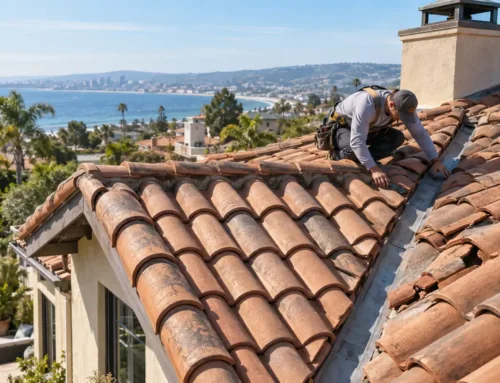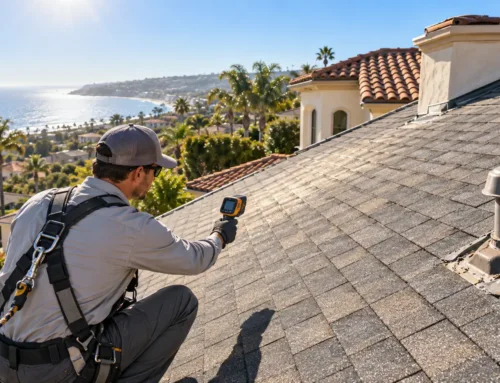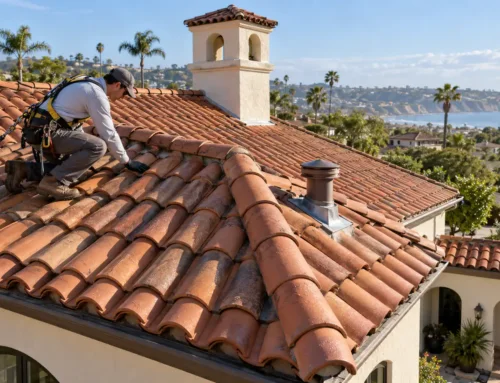
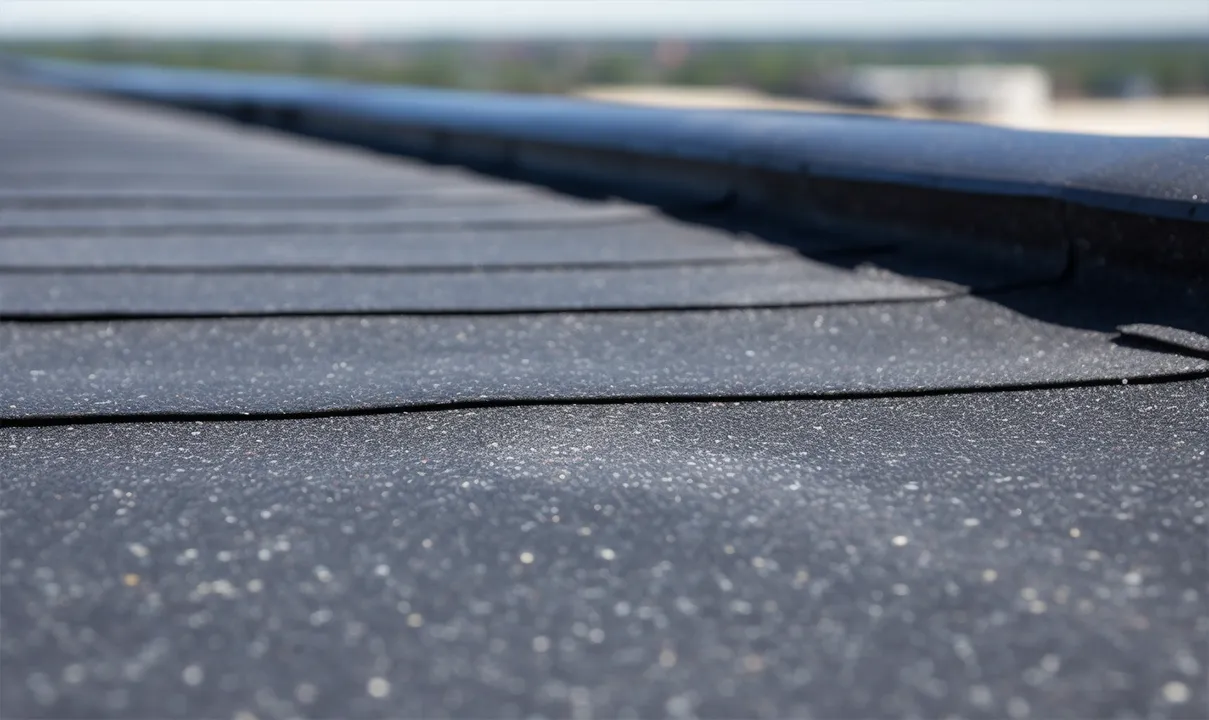
At San Diego County Roofing & Solar, we typically advise property owners to budget about $9 to $20 per square foot for a professionally installed modified bitumen roofing system in San Diego. A simple roof recover with limited preparation may fall near the lower end, while a complete tear-off with new insulation, cover board, drainage correction, flashing work, and a multi-ply membrane can reach or exceed the upper end. For a 1,500-square-foot low-slope roof, that creates a practical planning range of roughly $13,500 to $30,000 before major structural repairs or unusually difficult access are included.
Modified bitumen roof cost cannot be estimated accurately from membrane price alone. The finished roof is an assembly that may include deck repairs, vapor control, insulation, tapered drainage components, cover board, base sheets, cap sheets, flashings, edge metal, sealants, labor, permits, equipment, disposal, and warranty requirements. Two roofs with the same square footage can therefore have substantially different final prices.
Average Modified Bitumen Roofing Cost per Square Foot
| Project Type | Typical Planning Range |
| Basic roof recover with no major insulation upgrade | $8–$12 per sq. ft. |
| Two-ply replacement with tear-off and standard insulation | $13–$18 per sq. ft. |
| Three-ply or highly detailed system | $16–$22+ per sq. ft. |
| Small repair or very small roof area | Often higher per sq. ft. |
Current cost guides show why online estimates vary widely. A San Diego flat-roof guide lists basic modified bitumen installations around $5 to $9 per square foot, while a detailed 2026 assembly-based analysis estimates approximately $9 per square foot for a two-ply system without new insulation and close to $20 per square foot for a three-ply system with substantial above-deck insulation. The difference usually reflects what is included in the roof assembly.
A low number may cover little more than membrane installation on a clean, recoverable surface. A higher number may include demolition, disposal, code-required insulation, cover board, new drains, parapet flashing, edge metal, access equipment, and manufacturer-approved detailing. Property owners should compare scopes of work rather than only the price per square foot.
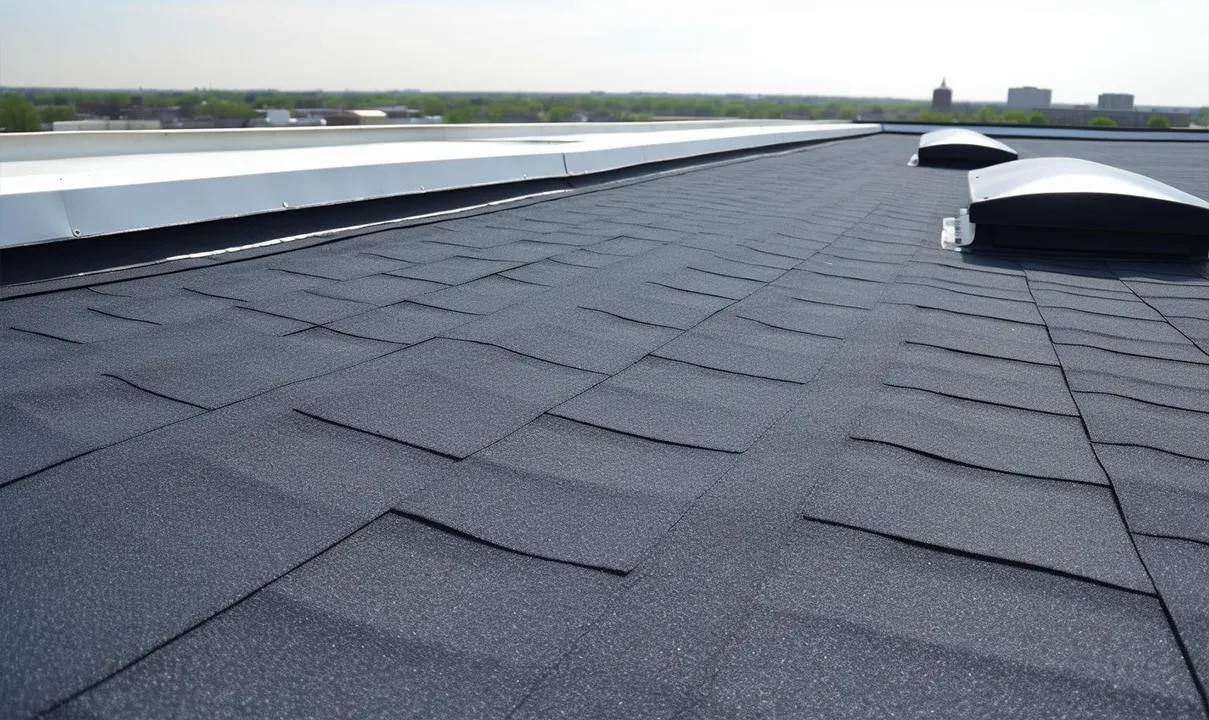
Modified Bitumen Roof Cost by Roof Size
| Roof Area | Estimated Installed Cost |
| 500 sq. ft. | $4,500–$10,000 |
| 1,000 sq. ft. | $9,000–$20,000 |
| 1,500 sq. ft. | $13,500–$30,000 |
| 2,000 sq. ft. | $18,000–$40,000 |
| 5,000 sq. ft. | $45,000–$100,000 |
These figures are planning allowances, not bids. Small roofs often cost more per square foot because setup, delivery, safety equipment, permitting, and cleanup are spread across fewer square feet. Large open commercial roofs may benefit from production efficiency, but rooftop equipment, tenant protection, phased work, restricted hours, and crane requirements can offset those savings.
What Is a Modified Bitumen Roofing System?
Modified bitumen is an asphalt-based membrane engineered for low-slope and flat roofs. Manufacturers blend asphalt with polymers to improve flexibility, strength, temperature performance, and resistance to movement. The membrane is reinforced with polyester, fiberglass, or a composite carrier and is commonly installed in two or three plies.
The two primary material families are SBS-modified bitumen and APP-modified bitumen. SBS gives asphalt more rubber-like flexibility, while APP gives it more plastic-like properties and is frequently used in heat-applied systems. A complete assembly may include insulation, high-density cover board, a base sheet, one or more interply sheets, and a granulated or coated cap sheet. This redundancy is a major advantage because water must pass through multiple bonded layers before reaching the building interior.
Factors That Affect Modified Bitumen Roof Cost
Tear-Off Versus Roof Recover
Removing an existing roof adds labor, dumpsters, hauling, disposal fees, and time. Tear-off may also reveal wet insulation, deteriorated decking, corroded fasteners, abandoned penetrations, or multiple old roof layers.
A roof recover can reduce cost when the existing assembly is dry, securely attached, compatible with the new system, and permitted by applicable codes. Recovering is not appropriate when moisture is trapped in the system, the deck is damaged, drainage is poor, or the roof already has the maximum allowable number of layers.
Insulation and Energy-Code Requirements
Insulation is often one of the largest cost variables. A full replacement over conditioned space may require multiple layers of rigid insulation, staggered joints, specialized fasteners, adhesives, and increased flashing heights.
Tapered insulation costs more than flat insulation because it creates slope toward drains, scuppers, or gutters. It can be an excellent investment when the existing roof holds water, but it requires a detailed layout and may raise curbs, transitions, and perimeter conditions.
Reflective surfacing may also be part of the specification in San Diego. The U.S. Department of Energy’s cool-roof guidance notes that cool roofs produce their greatest cooling savings in hot climates.
Number of Roofing Plies
A two-ply system generally includes a base layer and a cap sheet. A three-ply system adds another reinforced layer, increasing material, adhesive, and labor costs. The additional ply can improve redundancy and puncture resistance when the roof experiences frequent foot traffic or supports extensive mechanical equipment.
The least expensive specification is not automatically the lowest-cost roof over its full life. A stronger assembly may reduce leak risk and delay replacement, especially on multifamily and commercial buildings where interior disruption is expensive. Detailed cost modeling indicates that three-ply systems cost more initially but may provide a longer service life than comparable two-ply assemblies.
APP, SBS, and Installation Method
SBS membranes may be installed with hot asphalt, cold adhesive, self-adhering technology, or other manufacturer-approved methods. APP membranes are often torch-applied. The price difference between the materials is usually less important than reinforcement weight, sheet thickness, surface type, fire rating, warranty, and substrate preparation.
Torch-applied roofing requires trained crews, fire-safety procedures, suitable substrates, and careful planning around combustible construction. Cold-applied systems eliminate the torch but add adhesive and may require specific curing conditions. Self-adhered membranes can reduce fumes and flame exposure, although premium material pricing and detailed surface preparation may offset labor savings.
Roof Deck Condition
Modified bitumen cannot compensate for a weak deck. Damaged plywood, wood plank, lightweight concrete, gypsum, steel, or cementitious decking must be repaired before installation.
Deck repair is commonly handled as a unit-price allowance because the full extent may be hidden. An estimate should state the price per sheet, square foot, linear foot, or labor hour for replacement. Without that information, an initially low bid can increase sharply after tear-off.
Drainage and Ponding Water
A low-slope roof must move water efficiently. Clogged drains, undersized scuppers, settled insulation, structural deflection, and poorly located drainage points can leave standing water. Correcting the problem may require tapered insulation, crickets, drain replacement, larger scuppers, overflow drainage, or structural work.
Drainage upgrades increase the initial price but protect the entire roofing investment. Persistent ponding can collect debris, accelerate contamination, stress seams, and magnify small defects.
Flashings, Parapets, and Penetrations
Open roof field is relatively efficient to install. Cost rises at perimeter walls, skylights, HVAC curbs, pipes, drains, ducts, solar supports, equipment screens, and changes in elevation. Each penetration requires cutting, fitting, reinforcement, termination, and inspection.
Older San Diego properties frequently have stucco parapets, wood nailers, metal coping, abandoned equipment, and previous patching. Properly integrating these conditions may take more time than installing the field membrane. A detailed estimate should identify whether counterflashing, coping, sheet metal, curb work, or stucco repair is included.
Roof Access and Building Operations
A one-story building with open staging space is less expensive to roof than a multistory property with limited parking, narrow alleys, overhead utilities, or restricted delivery hours. Cranes, hoists, traffic control, interior protection, and daily cleanup add cost.
Occupied buildings may require phased installation, temporary waterproofing, odor controls, noise coordination, or after-hours work. Restaurants, healthcare facilities, schools, and multifamily properties often need additional planning to protect occupants and operations.
Permits and Warranty Requirements
Some projects require structural review, wind-uplift calculations, drainage verification, energy documentation, or special inspection. Manufacturer warranties may require approved contractors, specific insulation and cover boards, tested fastening patterns, and documented inspections.
A contractor workmanship warranty and a manufacturer material or system warranty are not the same. A longer or more comprehensive warranty can increase cost because the assembly must satisfy stricter requirements.
Modified Bitumen Repair Cost Versus Replacement
Localized repairs may be appropriate when the membrane is generally sound and the problem is limited to an isolated seam, puncture, drain, flashing, or penetration. Small repairs often cost more per square foot because the contractor must inspect, mobilize, clean, prepare, reinforce, and seal a limited area while matching an aged system.
Replacement becomes more economical when leaks appear in multiple locations, insulation is wet, the membrane is brittle or blistered, drainage is failing, flashings are broadly deteriorated, or prior repairs cover large portions of the roof. Moisture scanning, test cuts, and core samples can help determine whether damage is localized or widespread.
A coating can extend the service life of some modified bitumen roofs when the membrane is dry, stable, and properly prepared. It should not be used to conceal saturated insulation, open seams, or failed flashings.
How Long Does a Modified Bitumen Roof Last?
A properly designed and installed modified bitumen roof commonly provides around 15 to 25 years of service, with some well-maintained multi-ply systems lasting longer. Actual life depends on drainage, UV exposure, membrane thickness, installation quality, foot traffic, rooftop equipment, maintenance, and how quickly damage is repaired.
The National Roofing Contractors Association explains that service life is affected by climate, design, material suitability, application, and maintenance. It also describes maintenance as the “single most important factor after proper installation” in determining roof-system life and cost.
Regular inspections, clean drains, protected walk paths, prompt flashing repairs, and controlled rooftop access can change the long-term economics of the roof. NRCA roof maintenance guidance reinforces the importance of maintaining low-slope membrane systems.
Is Modified Bitumen Worth the Cost?
Modified bitumen is often a strong value for small commercial buildings, multifamily properties, garages, additions, and residential low-slope roofs. Its multi-layer construction provides durability, familiar repair methods, and good resistance to punctures and routine rooftop activity.
Compared with TPO or PVC, modified bitumen is heavier and involves more seams, but its layered construction can be advantageous around complex parapets and penetrations. Compared with traditional built-up roofing, it can deliver similar asphalt-based performance with factory-produced sheets. The best choice depends on roof geometry, energy goals, chemical exposure, fire restrictions, traffic, expected ownership period, and budget.
The decision should be based on total installed scope and expected service life rather than membrane price alone. A slightly higher bid may be the better value when it includes wet-insulation removal, drainage correction, stronger cover board, improved flashing, reflective surfacing, and a meaningful warranty.

What a Complete Roofing Estimate Should Include
A reliable proposal should identify the measured roof area, tear-off assumptions, disposal, deck-repair unit prices, insulation type and thickness, drainage plan, cover board, membrane manufacturer, APP or SBS formulation, number of plies, installation method, cap-sheet surface, flashing details, sheet-metal work, permits, warranty, exclusions, and payment schedule.
It should also explain how unexpected moisture or structural damage will be documented and approved. Vague descriptions such as “install torch-down roof” do not define the assembly well enough for comparison. We recommend comparing membrane thickness, reinforcement, insulation, attachment, flashing design, and warranty obligations line by line.
Conclusion
A modified bitumen roof in San Diego will generally cost about $9 to $20 per square foot, with basic recover projects sometimes costing less and complex replacements exceeding that range. Roof size matters, but insulation, tear-off, deck condition, drainage, penetrations, access, installation method, reflective requirements, and warranty specifications often have a greater effect on final price. San Diego County Roofing & Solar can determine the appropriate scope only after evaluating the existing membrane, moisture conditions, deck, flashings, drainage, and energy requirements; that inspection is what turns a broad online estimate into a dependable project budget.
Frequently Asked Questions
How much does a 1,000-square-foot modified bitumen roof cost?
A 1,000-square-foot modified bitumen roof commonly costs about $9,000 to $20,000. A clean recover with no major insulation or deck work may be near the lower end. A full tear-off with new insulation, cover board, drainage improvements, and a multi-ply system will be closer to the upper end or higher.
Is modified bitumen cheaper than TPO roofing?
Modified bitumen can be less expensive on a basic installation, especially on a small or detail-heavy roof. TPO may be more competitive when reflectivity, lightweight construction, and fast installation over large open areas are priorities. The comparison must include insulation, tear-off, flashing, drainage, and warranty scope rather than membrane price alone.
Can a new modified bitumen roof be installed over an old roof?
A recover may be possible when the existing roof is dry, securely attached, compatible, structurally sound, and permitted by code. It is not appropriate when insulation is wet, the deck is damaged, drainage is poor, or too many roof layers are present. A professional inspection and, when necessary, moisture testing or test cuts should determine whether recovery is suitable.